

Everything You Need to Know
About Your Heart Hero AED
Explore our user stories, easy-to-follow guides, instructional videos, FAQs and
expert tips to help you stay prepared and confident in any emergency.
-
Read more: How to support Heart Health during the winter

How to support Heart Health during the winter
According to the British Heart Foundation, heart attacks are more common during the coldest season¹. During this time of year,…
-
Read more: Defibrillator myths debunked: Time for some fact-finding!

Defibrillator myths debunked: Time for some fact-finding!
Some 80% of cardiac arrests happen at home. This blog article was written to debunk the most common defibrillator myths…

Frequently Asked
Questions
Sudden cardiac arrest is triggered by an electrical malfunction in the heart that causes an irregular heartbeat (arrhythmia). It occurs suddenly and typically without warning. The heart’s pumping action is interrupted and it can’t effectively pump blood to the body’s organs. Shortly after, a person loses consciousness and will have no pulse. If an individual who has suffered cardiac arrest doesn’t receive treatment, death may occur within minutes.
Sudden cardiac arrest is not the same as a heart attack. A heart attack refers to a blockage of blood flow to the heart, whereas a sudden cardiac arrest is when the heart stops beating suddenly due to an ‘electrical’ malfunction.
No, people of all ages can have a sudden cardiac arrest. The most common cause is ventricular fibrillation, an irregular heart rhythm.
No, anyone can be affected by sudden cardiac arrest. Worldwide, sudden cardiac arrest is responsible for the deaths of more than 7 million people a year as cited by medscape.
Defibrillators can be found in public places, but the vast majority (80%) of sudden cardiac arrests happen at home. Every second matters when it comes to a lifesaving intervention, and HeartHero allows critical care to be delivered before an ambulance arrives.
An automated external defibrillator (AED) such as HeartHero is used when someone is unresponsive and not breathing normally, or not breathing at all. An AED only shocks the heart if needed, so it is better to apply the pads when in doubt.
Using an AED to deliver an electrical shock is the sole way to treat sudden cardiac arrest. Cardiopulmonary resuscitation (CPR) can keep oxygen being supplied to the brain, but is incapable of restoring the heart’s rhythm.
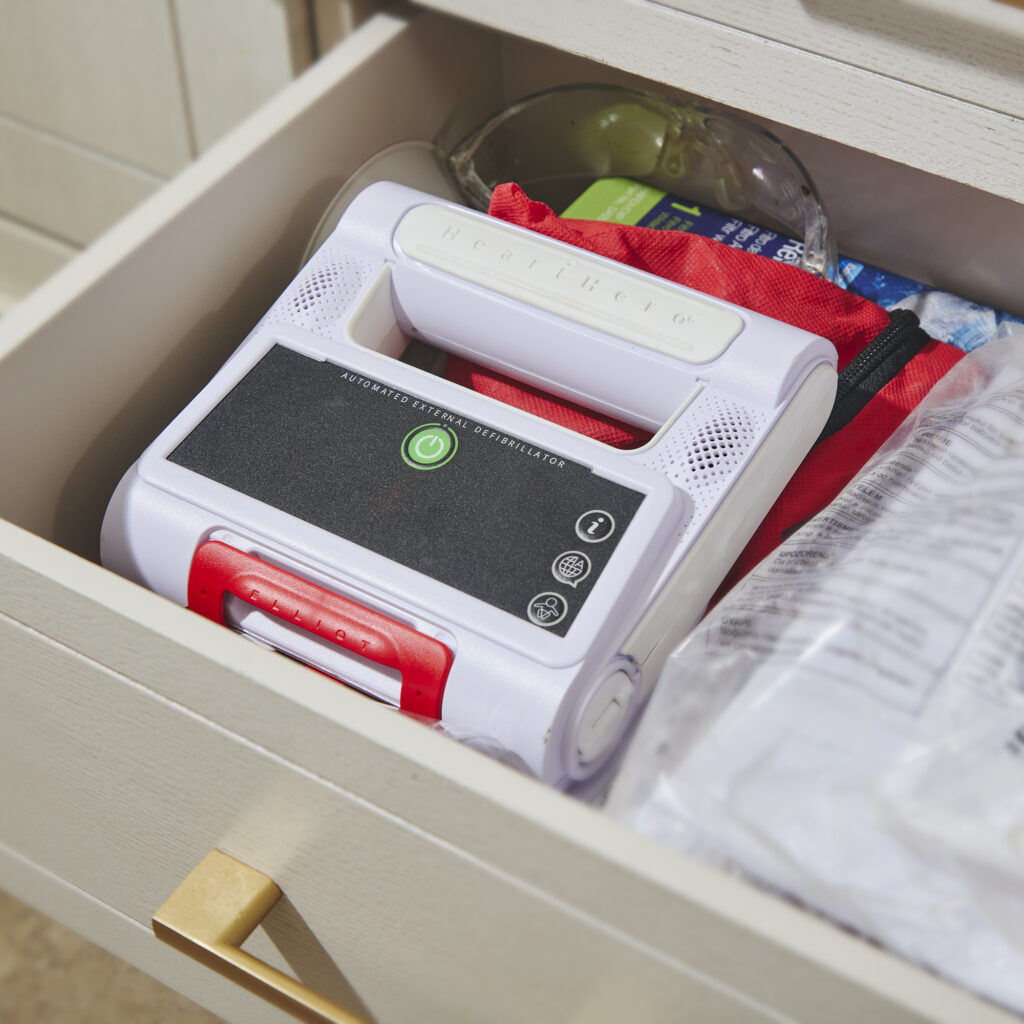
HeartHero is designed to be easy to use. It provides visual and audio prompts to guide users through the process. After the green power button is pushed, the red tab is pulled to turn on the device and release the pads. When the sticky pads are applied to the chest, HeartHero reads the person’s heart rhythm to determine if a shock is needed, before warning the user to stand back and delivering the shock. HeartHero will not shock a person if their heart does not need shocking, making it safe to use if in doubt that a person is in sudden cardiac arrest.
No, HeartHero is lightweight and ultra-portable, fitting easily in your bag or vehicle glovebox. It is a lifesaving device that you can take anywhere.
Yes; not only is HeartHero water resistant – being able to withstand exposure to moisture such as a spillage or leaking water bottle in your bag – but it is also dustproof and can operate in extreme temperatures.
HeartHero uses one set of pads for both adult and child use. Not only does this avoid any potential mix-ups during usage, but it also helps to keep the device affordable and accessible.
The price of HeartHero in the UK is £500. Navigate to our Product section to order HeartHero now.
HeartHero with pads and batteries included weighs 0.590 kg. Its dimensions are 16 cm x 15.5 cm x 4.3 cm, and it has an integrated ergonomic handle.
You do not need formal training to use HeartHero. The controls are easy and intuitive, with clear visual and voice instructions.
Yes. HeartHero has the UKCA Mark and CE Mark, making it available in the UK and 32 other countries